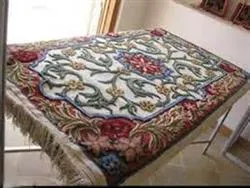
India is located in South Asia and the north of the Indian Ocean and Southwest China, the East of Pakistan, and 3287590 square kilometers wide. About one-fifth of the country’s population in cities, including New Guinea, Mumbai, Kolkata, Hammonds, Hyderabad, and the rest in villages are employed in agriculture and livestock and its side-effects. The people of India can be considered an example of an interest in handicrafts, especially weaving, lia, liaise, gravitation, of manual artifacts of these people, while providing some of these artifacts that are not adapted to the nature of the people and the climate of the place, for example: the carpets and the use of the public in the field, which is largely accepted by the locals. Iranian rugs have first introduced the texture and consumption of carpets in India with the design and role of Iranian rugs, Iran’s carpets have moved to India with its particular variety along with Iranian rugs, and are woven and exported with the high wool of Kashmir and the Himalayas, and despite the economicity of this work and the considerable profit of that group, it is now considered important to India in terms of the world’s exports. The wool obtained from sheep, which is mostly cultivated in the provinces of Otar Pradesh and “Jews”, does not supply more than two-thirds of the country’s carpet industry’s demand and import surpluses from the countries of Zeldeno and Australia. Large carpets and industries in India, and especially in the state of “Har Pradesh” are implemented, and labour laws apply for workers, including carpets across the country, and are banned from the use of children more than 14 years in India, silk carpets are also woven, and India is in the important category of the countries exporting silk carpets. Indian hand-made rug sizes are determined by the order of the applicants, but the common sizes are usually described as follows: A-Khal from “1/83× 2/74 to 3/66×4/57 meters.” b) The rug of 0/92× 1/83 to 1/2× 2/14 meters. Most Indian rugs under the "26" and only 5% of carpets are "32 to 40" and the nodes of the asymmetric Persian rugs, and the thickness of hand-mades is also questionable. cotton is cultivated and harvested in India, and the use of cotton fibers in textiles of the people of this land has a multi-thousand-year history, and now, despite the increasing volume of cotton production, the demand of industries. Local governments, especially in the two states, “Jews and Otar Pradesh” try to enforce the provisions of the financing of carpets and enhance their professional knowledge levels, and these provisions, which are implemented in the context centers only in public workshops, include wages, working conditions, workplace training and increased skills of the working environment and other workers. The use of brand names and trademarks for factories or businesses is also common in India. Today, the public layout of Indian handmade rugs is a set of Iranian, Chinese, French, Turki maps that local skilled designers take as much as possible and give to the barns, “65 percent of India’s rug designs have Iranian maps such as sars, concussions, summarys and other peoples, such as “the art and other people of India.” Some other types of ordinary Indian rugs are as follows (with-processing): 1 “Agra” which is a type of thick rug from the mixture of cotton and cotton and the colors used in that blue, green, brown. God’s Word is full and full of wine. 3) “easy” is the small rugs of Johnmazi, of the special white wool of prayer and worship consumed in India and Pakistan. 4) “Anger” is a kind of bouquet with cotton in the Punjab. 5 "The door" is a kind of awe, and its textures have been common in India since ancient times. 6 "The types of large cloth carpets that are woven for mosques.